The two halves of a genius
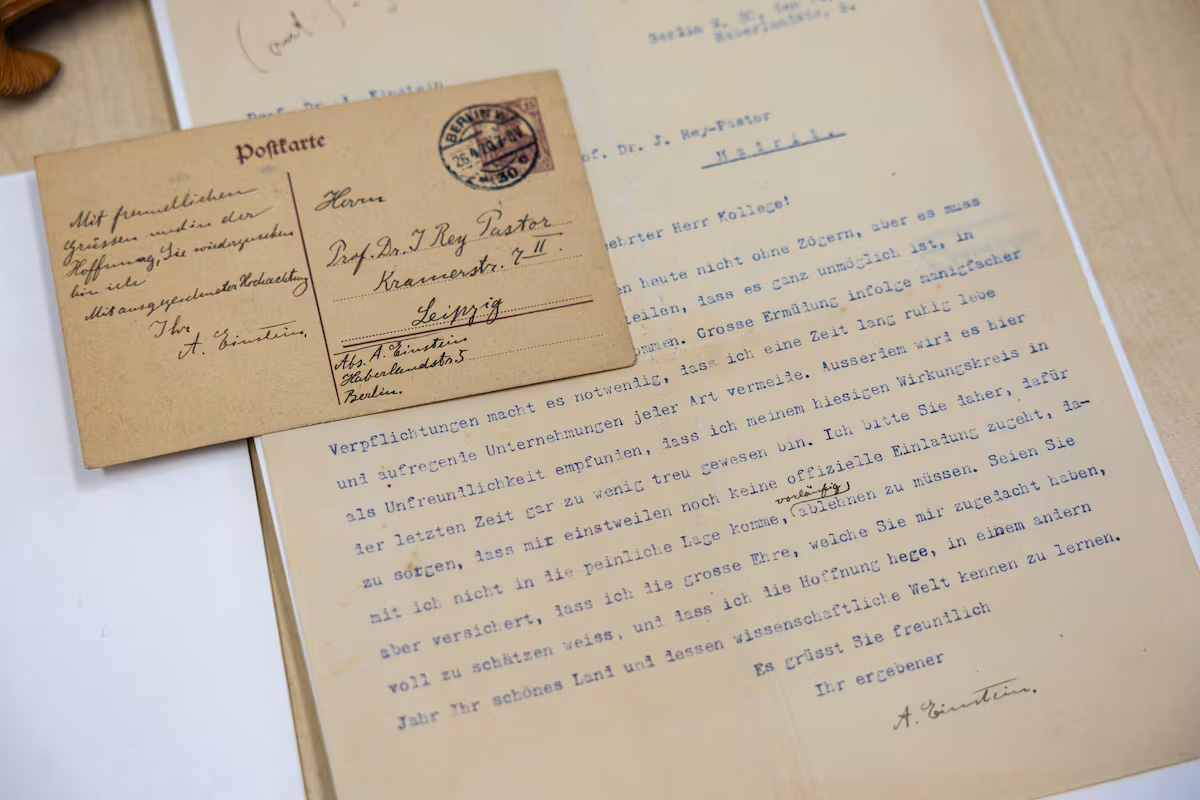
Postcard and letter from Einstein received by Julio Rey Pastor – Photo: Pablo Monge
CSIC Recovers the Valuable Unpublished Archive of Mathematician Julio Rey Pastor
The Spanish National Research Council (CSIC) has received a valuable and previously unpublished historical treasure consisting of 131 documents and objects belonging to the Spanish mathematician Julio Rey Pastor (1888–1962). The legacy, carefully preserved by his family and sent from Argentina by his granddaughter, María Rey Pastor, will become part of the institution’s Jorge Juan Library. This event represents a major archival milestone, as it makes it possible to reunite, under one roof and for the first time in nearly a century, the two halves of the scientist’s life and work: his early years in Spain and his subsequent professional development in South America.
Among the most remarkable discoveries recovered from the five donated boxes is a high-society fan containing dedications and epigrams signed by intellectuals such as José Ortega y Gasset, together with a mathematical poetic manuscript written by Rey Pastor himself. However, the items that have generated the greatest historical fascination are two unpublished epistolary treasures linked to Albert Einstein: a postcard and a typewritten letter dated July 1920. In this letter, the German physicist politely declined an invitation to give lectures in Spain, citing a delicate state of health caused by the hardships of post-war Berlin, a refusal that came three years before his celebrated trip to the Iberian Peninsula in 1923.
Beyond the undeniable appeal of the correspondence with Einstein, experts and institutional archivists emphasize that the most significant part of the donation lies in the mathematician’s working notebooks. These handwritten notes document his formative stays in Berlin and Göttingen in 1911 and 1913, both leading centres of scientific avant-garde at the time. Rey Pastor, historically described as a brilliant, incisive, and complex solitary figure, used the knowledge acquired there to wage a genuine intellectual battle against Spain’s old academic establishment, demanding “carnivorous researchers” for the country rather than merely passive teachers.
The archive also sheds light on his “Atlantic duality,” a period that began in 1917 after he was invited to Buenos Aires, where he eventually settled permanently in 1921. In Argentina, Rey Pastor built a mathematical school virtually from scratch, creating doctoral programmes, founding the Argentine Mathematical Union, and providing refuge for scientists exiled by European fascism, while maintaining a life divided between both hemispheres. With this official donation, which is already being digitised for public access through the SIMURG platform, the genius’s prolonged family and geographical absences are transformed into a unified historical presence within the Hispanic cultural heritage.
Source: Elpais.com