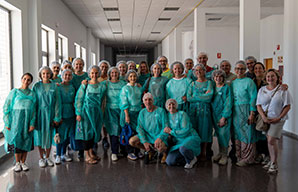
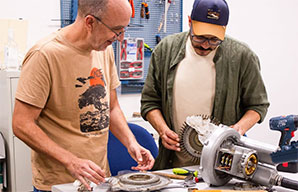
Last Thursday, 22 October, the 1st Fine Arts Gala @bellasartesaltea was held at the Altea campus. The event took place in the Mascarat building and benefited from the technical support of our #SATDI colleagues, Josep Galvany (audiovisual controls) and Roc Gomar (3D printing of the awards). The event brought together art, music and recognition of...
A small robotic arm capable of grasping objects underwater thanks to algae. It is the result of research at Delft University of Technology in the Netherlands, which combines living cells and synthetic materials to transform light into movement. The team, led by researcher Marie-Eve Aubin-Tam, has developed a flexible strip approximately two centimeters long and...
Research led by the University of Cologne and published in the journal Nature has found that low temperatures induce muscles to produce the molecule BH2 (dihydrobiopterin). This metabolite travels to other organs and activates proteostasis, the cellular mechanism responsible for properly maintaining, repairing and eliminating proteins. It was already known that cold temperatures could...
A study by the Institute of Marine Sciences (ICM-CSIC) shows that rising water temperatures increase the toxicity of certain chemicals found in plastics, threatening tiny organisms that play an essential role in maintaining healthy marine ecosystems. Climate change and plastic pollution may pose a greater combined threat than previously thought. A study led by researchers...
The 2026 Nobel Prize in Physiology or Medicine, announced this Monday, has been awarded to Karl Deisseroth, Peter Hegemann and Georg Nagel, the pioneers of optogenetics, an innovative technology that makes it possible to turn the activity of individual nerve cells on or off in a living brain. It allows neurons to be controlled using...
A study published in the journal Nature analyzes the potential use of medicinal plants by African elephants in the Mount Elgon region of Kenya. The research compiles observations on the selective consumption of certain natural resources and examines their possible relationship with self-medication behaviors. The research combines the study of animal behavior with the traditional...
A medical team at Hospital Universitario La Paz in Madrid has developed an experimental technique aimed at enabling the recipient’s body to tolerate a transplanted organ as if it were its own. The procedure, based on a “double graft”, combines organ transplantation with hematopoietic stem cells from the same donor, which undergo a purification process...
A team of palaeontologists from the Fundación Conjunto Paleontológico de Teruel-Dinópolis has identified remains belonging to a Diplodocus at the La Tejería fossil site in El Castellar, Teruel. The dinosaur lived around 150 million years ago, during the Late Jurassic. The discovery, published in the scientific journal Journal of Vertebrate Paleontology, is exceptional because...
Tim Andrews, 66, received a transplant of a genetically modified porcine kidney in January 2025. The procedure was performed at Massachusetts General Hospital in Boston, and Andrews lived with the kidney for 271 days. During that period, he was able to stop dialysis, which had kept him alive until then. In a study published earlier...
Stopping bleeding as quickly as possible can be crucial in an emergency, surgery, or accident. However, it's not always easy, especially when wounds are deep, irregular, or difficult to cover with standard materials. A research team from the Korea Advanced Institute of Science and Technology ( KAIST ) has developed a new powdered material that...