Oceans at the center of the Earth?
For decades, scientists have known that our planet’s core isn’t made of just iron and nickel. They know this because there’s a “density deficit”—the Earth’s center is lighter than it should be. What secret ingredients complete the recipe? A new study published in the journal Nature Geoscience has revealed a fascinating element: hydrogen.
Studying the core is impossible through drilling (we’ve barely scratched the surface to a depth of about 12 km). Therefore, the team used advanced high-pressure and high-temperature techniques to simulate the extreme conditions that exist 2,900 kilometers beneath our feet.
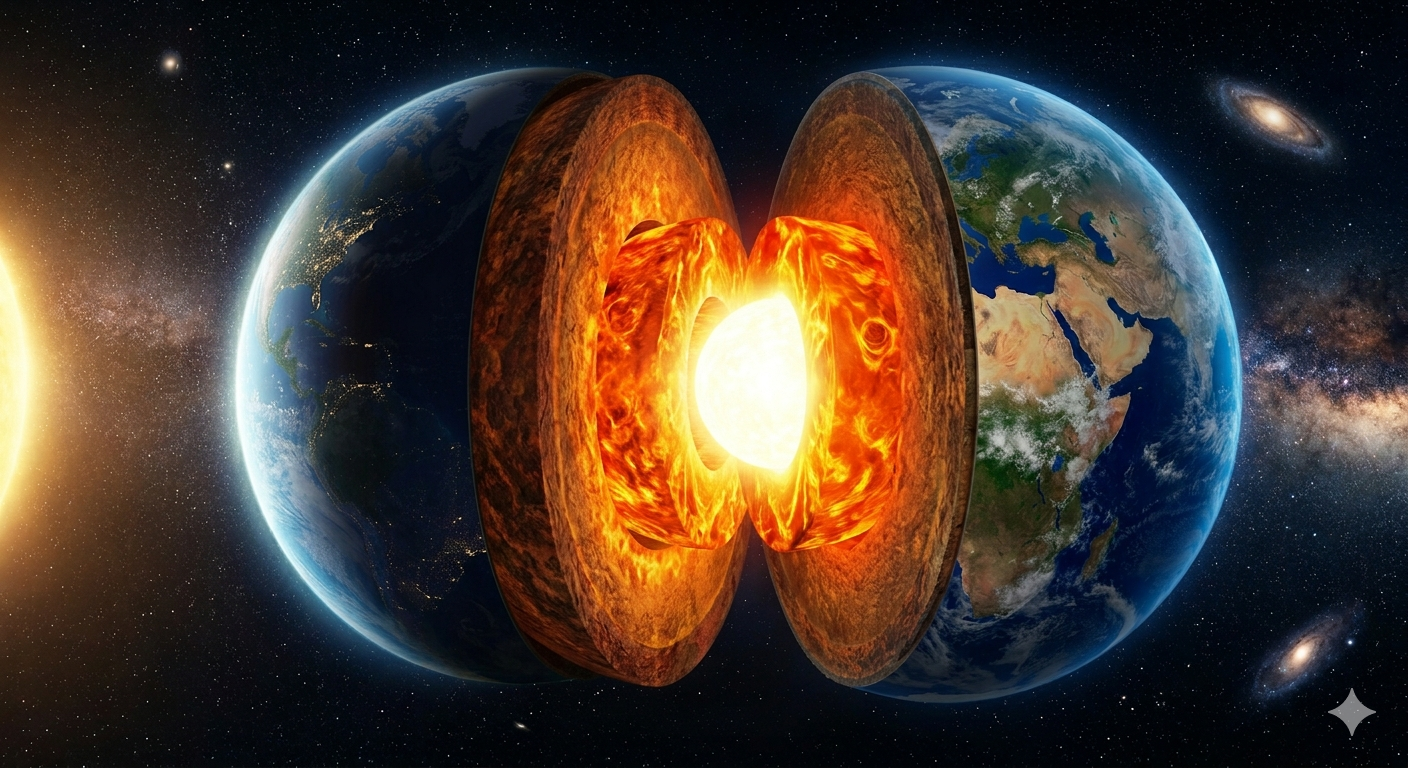
Using diamond anvil cells and high-resolution analysis, the scientists quantified how much water (in the form of hydrogen) could have been absorbed by the molten iron during Earth’s formation.
The study reveals surprising results, such as the fact that Earth’s core could contain a vast amount of hydrogen, equivalent to several times the mass of all the surface oceans combined.
This discovery changes our understanding of, firstly, the origin of water. It suggests that many of the elements that make up water were present from the planet’s birth, trapped deep within, rather than arriving solely through impacts from external asteroids. Secondly, it changes our understanding of the planet’s evolution. Hydrogen in the core affects how heat is transported and how the magnetic field that protects us from solar radiation is generated.
This finding is important because knowing exactly what the Earth’s core is made of helps us understand not only our past but also the habitability of other planets. If hydrogen is a common component in planetary cores, the “recipe” for a living planet could be more complex than we imagined.