A century of psychology at the Complutense University of Madrid
The new Complutense Museum of Psychology opens its doors this week at the Faculty of Psychology of the Complutense University of Madrid , with a tour that reviews more than a century of scientific history through original instruments, emblematic experiments and key figures in the discipline. Directed by Professor Javier Bandres , the space brings together materials from the first experimental psychology laboratory in Spain to devices that anticipated current debates on behavior, learning and persuasion. Among the most outstanding pieces is the installation that recalls the 1942 experiment by the American psychologist Leo Crespi , whose research demonstrated that the expectation of reward can influence behavior more than the reward itself.
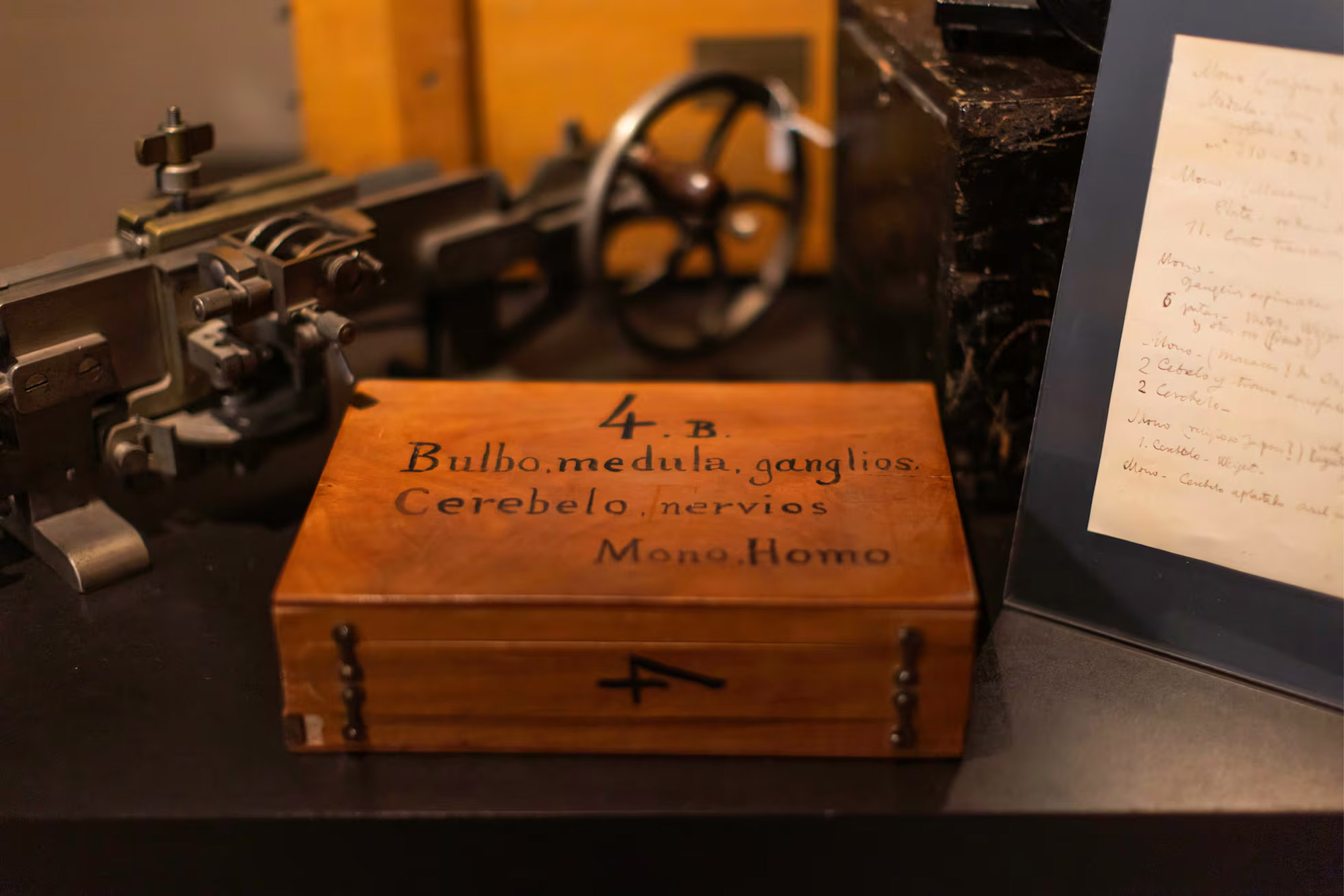
Sample box used by neurologist Luis Simarro – Photo: Inma Flores – El País.
The museum, which will open by appointment at the Faculty of Psychology of the Complutense University of Madrid , pays tribute to the pioneers of the discipline in Spain. One room is dedicated to Luis Simarro , whose laboratory was the seed of decisive advances for Santiago Ramon y Cajal . Another remembers Mercedes Rodrigo , the first person to graduate in Psychology in Spain, promoter of psychotechnics and defender of the detection of child talent. The tour does not avoid dark episodes, such as the repressive drift of certain approaches to criminal psychology in the post-war period.
The exhibition culminates with instruments that marked the scientific evolution of the discipline, such as BF Skinner ‘s famous box , a paradigm of operant conditioning, whose principles —Bandrés warns— still resonate today in the addictive logic of mobile phones. It also features the tachistoscope and references to the Weber-Fechner law, which inaugurated quantitative psychology. After reviewing decades of experiments and theories, the director vindicates the academic essence of the discipline with a sober conclusion: beyond historical devices, the fundamental instrument is “a person who knows and a blackboard.”
Font: elpais.com